




Bullets, Numbers and Lists: How Small Errors Have a Big Impact
15 November, 2011
Which stands out more: structuring sentences into a paragraph or breaking them into a bulleted/numbered list?
| Sentences in a paragraph | A bulleted list |
|---|---|
| Most text in reports, articles and proposals appears as sentences in paragraphs. Each sentence leads on to the next one. However, when under time pressure, or especially when reading web pages, readers often skip over sentences. |
|
Lists, bullets and numbers help to make text stand out (especially when they're used sparingly). But if there are errors in the text, those errors will stand out too. It doesn't matter that details like capitalization or punctuation inconsistencies seem small. The truth is that if they're in a bulleted/numbered list, they'll leap out at readers.
What Matters Is Consistency
If items in a list are full sentences, then they should start with a capital letter. If not, then capitalizing the first letter is optional.
“If your list item isn't a complete sentence, you can choose whether or not to capitalize the first letter - it's a style issue. The only thing that is important is to be consistent.” — Mignon Fogarty, aka Grammar Girl
In the same way, if items in a list are full sentences then they should end with a full stop, question mark or exclamation mark. If they're not sentences, then options include commas, semi-colons and no punctuation. Once again, the key is consistency.
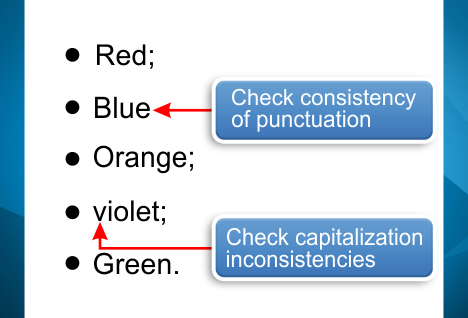 Figure 1: Consistency matters in lists
A Shockingly Common Error
We decided to test if authors actually stick to these rules. We used PerfectIt – Intelligent Editing's add-in for MS Word – to check 2400 documents published online for inconsistencies. PerfectIt provides a powerful way to compare the frequency of inconsistencies because it automatically checks bulleted and numbered lists for both capitalization and punctuation inconsistencies.
Each of the 2400 documents we tested was over 1000 words and was downloaded from the internet using the search term "final report".
The results were shocking. Over 4 in 10 documents suffered from inconsistent punctuation of bulleted/numbered lists. Furthermore, 7% suffered from inconsistencies in capitalizing lists. But that's not all. Of those 2400 documents, 600 didn't contain any bulleted or numbered lists. So if we restrict the analysis to documents that contained lists, then the proportion is even higher. In fact, more than half the documents published online that contain lists have problems with inconsistent bullet punctuation.
Things Can Only Get Better
It's easy to be downbeat about the frequency of errors creeping into documents. However, it's actually an opportunity. It takes only a small amount of extra care and attention to make sure that your documents don't suffer from these mistakes. With a bit of extra checking, your proposal, article, thesis or report will stand out from the crowd in the best way possible.
A great way to achieve this is to use PerfectIt. PerfectIt checks every bulleted and numbered list in your document in seconds, giving you the option to quickly correct any inconsistencies. Moreover, PerfectIt can be customized to check your style guide and your preferences. So you can be confident that your documents look the best they can.
PerfectIt comes with a free trial and can be downloaded from the Intelligent Editing website.